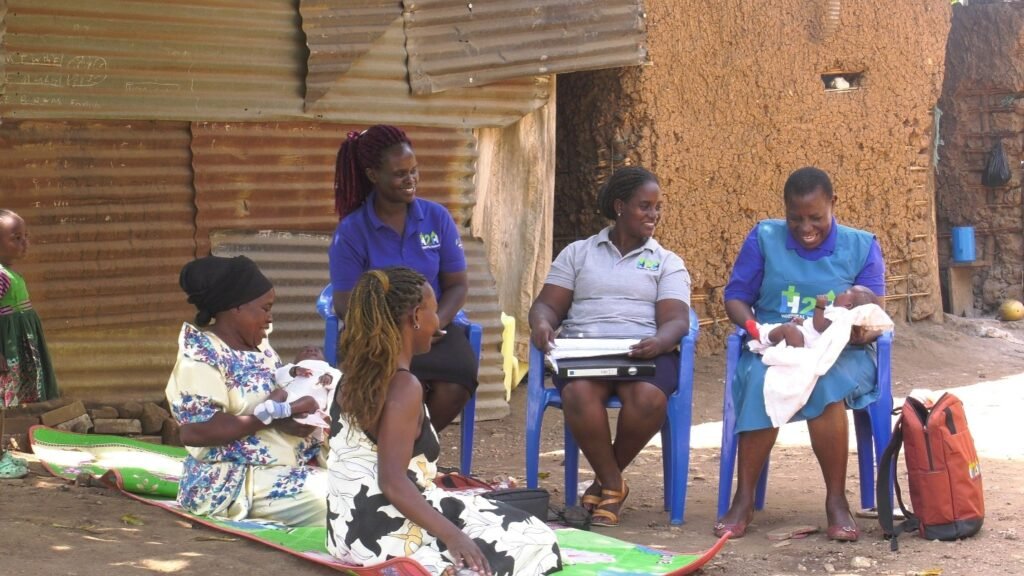
Cornety Nakiganda Kivumbi, H2H Programme Lead, joyfully carrying one of the twins during a home visit to a mother in Kiwoko district , accompanied by the Hospital to Home Programme team, including Nasuuna Jesca (VHT) and Seela Margret
By Prof. Peter Waiswa
Every year, approximately 15 million babies are born too soon. For these babies, the journey into life often begins with a struggle for survival. Some are born weeks or even months before their expected date of delivery, while others weigh less than 1,000 grams. Many require specialised hospital care to help them breathe, maintain their body temperature, feed, fight infections and grow strong enough to go home.
Advances in newborn care have significantly improved the chances of survival for these vulnerable babies. Through interventions such as kangaroo mother care, improved feeding practices, respiratory support, infection prevention and better newborn services, more preterm babies are surviving.
However, survival is only the beginning.
When a preterm baby is finally discharged from hospital, families celebrate. Mothers and fathers look forward to taking their babies home, while health workers celebrate another life saved and health systems record another newborn survival success.
Yet, beneath this relief lies a different reality. For many families, the challenges of caring for a preterm baby are only beginning.
Will the baby continue to gain weight? Will breastfeeding be sustained? Will the baby avoid infections and other complications? Who will monitor growth, hearing, vision, movement, communication and learning? What happens when developmental difficulties become apparent months or years later? And who supports the mother, who may be physically exhausted, emotionally distressed and financially overwhelmed after weeks or months of caring for a fragile newborn?
These questions are central to this year’s World Prematurity Day theme;“Small babies, big potential. Invest in follow-up care to protect their future!”
The message is both hopeful and urgent. Every baby born too soon deserves the opportunity to survive, grow, develop and reach their full potential. However, this cannot be achieved through hospital care alone. It requires sustained investment in children, mothers and families, long after the hospital discharge papers have been signed.
As we mark World Prematurity Day 2026, Uganda’s experience offers an important lesson to the world; saving a preterm baby’s life is an essential achievement, but ensuring that the child continues to survive, develop and thrive must be our ultimate ambition.
Prematurity remains a major global child survival challenge
Globally, an estimated 13.4 million babies were born preterm in 2020, representing approximately one in every ten live births. Complications of prematurity remain the leading cause of death among children under five, with the burden particularly severe in sub-Saharan Africa and South Asia.
In response, Uganda has made important investments in improving care during childbirth and the newborn period. More health facilities now provide newborn resuscitation, kangaroo mother care, feeding support and treatment for sick and small babies.
Our collaborative research through the Preterm Birth Initiative in Uganda and Kenya has also contributed to efforts to improve the quality of childbirth and immediate newborn care. For instance, a cluster-randomised trial published in The Lancet Global Health in 2020 evaluated quality improvement interventions targeting stillbirths and neonatal mortality among preterm and low-birthweight babies.
While these investments are important, they have also brought into focus a critical gap that receives far less attention: what happens to these vulnerable babies after they leave hospital?
The danger does not end at discharge: Evidence from Busoga
Evidence from our research in eastern Uganda illustrated why this question matters.
In a prospective study conducted in six hospitals in Busoga, our research team followed 128 preterm babies during the neonatal period after discharge. Ten of these babies died, representing approximately 8% of those followed.
Although these babies had survived their initial hospital care and were considered sufficiently stable to return home, some did not survive the transition from hospital to community care.
The study also identified associations involving feeding practices, maternal HIV status and kangaroo mother care. These observational findings require cautious interpretation and should not be taken as evidence of causal relationships.
Nevertheless, the findings highlight an important concern: surviving hospitalisation does not necessarily mean that a preterm baby is out of danger. Vulnerability continues after discharge, particularly where families have limited access to follow-up services and support.
This makes hospital discharge not the end of care, but the beginning of another critical phase. It must therefore be accompanied by a carefully planned transition, with clear responsibilities for health facilities, community health workers and families.
Uganda is demonstrating that hospital-to-home care is possible
While the evidence points to significant gaps, there are also encouraging examples of how continuity of care can be strengthened.
In central Uganda, collaborative work involving Kiwoko Hospital, Adara Development and partners evaluated the Hospital to Home (H2H) programme, which was designed to support small and sick newborns after discharge.
Cornety Nakiganda Kivumbi, H2H Programme Lead, joyfully carrying one of the twins during a home visit, accompanied by the entire H2H Programme team, including Nasuuna Jesca (VHT) and Seela Margret
The programme sought to bridge the gap between hospital and community care through discharge preparation, caregiver education, breastfeeding support, home visits by trained community health workers and referral pathways.
A study published in BMJ Global Health in 2025 compared 100 newborns receiving the intervention with 91 newborns in a historical comparison group.
The findings were encouraging. Exclusive breastfeeding at six months was reported among 42% of babies in the intervention group, compared with 6.6% in the comparison group. Vaccination completion was also higher, at 88.5% compared with 76.9%. Families and health workers further found the programme feasible and acceptable.
However, the study did not demonstrate a statistically significant improvement in neurodevelopmental outcomes at six months.
Taken together, these findings suggest that structured hospital-to-home support can improve important aspects of newborn care, although further research is needed to establish its effectiveness, particularly in relation to longer-term developmental outcomes.
The experience also demonstrates that continuity of care is possible. What is now needed is deliberate organisation, adequate financing and integration of these approaches into routine government health systems so that more families can benefit.
Mothers and families are central to preterm survival
Beyond the health facilities and community follow-up programmes, mothers and families remain central to the survival and development of preterm babies. Their experiences must therefore be part of any discussion about improving care.
A Mother with her thriving twins at home in Kiwoko supported through H2H Model
Mothers often spend prolonged periods in newborn units providing kangaroo mother care, expressing breast milk and supporting their babies’ feeding. Our qualitative research on parental participation in newborn care has highlighted the importance of relationships between parents and healthcare providers in supporting this involvement.
However, mothers should not be viewed simply as an additional workforce for overstretched hospitals. Their own health and wellbeing matter.
Many return home still recovering from complicated deliveries while facing poverty, food insecurity, anxiety, depression and limited family support. At the same time, they are expected to care for a medically fragile baby alongside other children, household responsibilities and livelihood activities.
Breastfeeding, for instance, is particularly important for preterm babies. However, sustaining it may require continued professional guidance, individualised feeding plans and practical assistance to overcome feeding difficulties.
Equally important is the involvement of fathers, grandparents and other family members. Caring for a preterm baby should be a shared family responsibility, supported by health workers and communities.
What our Ugandan research tells us about the burden on caregivers
Beyond the clinical needs of preterm babies, our Ugandan research also highlights the often-overlooked burden placed on mothers and other caregivers, particularly when children experience developmental difficulties.
In my 2025 World Prematurity Day address at Kawempe Hospital, I presented findings from our local maternal and newborn research that deserve greater attention.
In one cross-sectional study involving 487 infant–mother pairs, 62 infants (12.7%) had neurodevelopmental difficulties in at least one assessed domain, while nine (1.8%) had severe difficulties.
Related qualitative research involving 14 caregivers and five health workers further explored what these experiences mean for families. Caregivers described raising children with neurodevelopmental difficulties as impoverishing, emotionally stressful and, at times, imprisoning. Some attributed developmental difficulties to supernatural causes, while others spoke of limited community support and inadequate responses from the health system.
These accounts reveal a challenge that is often missing from routine health-system statistics. When follow-up, rehabilitation and social protection services are inadequate or unavailable, families bear enormous financial, emotional and social costs.
Similarly, other Ugandan research presented at Kawempe Hospital during World Prematurity Day highlighted the psychosocial challenges experienced by mothers providing kangaroo mother care at home. These included uncertainty, inadequate support and, in some cases, unsafe attempts to keep babies warm.
Importantly, caregivers’ confidence depended heavily on how well they had been prepared before discharge and how clearly health workers communicated with them. Mothers also proposed peer-to-peer support led by experienced mothers, alongside continued follow-up by qualified professionals and community health workers.
Taken together, these findings reinforce the need for family-centred newborn care. Parents need more than instructions at discharge; they need practical knowledge, confidence, emotional support and continued access to professionals when challenges arise.
Prematurity does not end in infancy: The long-term consequences
The need for sustained support becomes even more evident when we consider that the effects of prematurity can extend well beyond infancy.
Depending on how early they were born and the complications they experienced, some preterm children face difficulties with growth, movement, vision, hearing, learning, behaviour or social development. Others may experience respiratory or other health challenges later in life.
A 2025 paper published in Early Human Development highlights the experiences and challenges of adults born preterm, further demonstrating why the consequences of being born too soon deserve attention across the life course.
This does not mean that every baby born preterm will experience lifelong health problems. Many grow into healthy adults and lead fulfilling lives. However, the increased risks among some survivors make developmental monitoring, early identification and timely intervention essential.
For this reason, follow-up should not automatically end at six weeks or six months. Some children need continued support through preschool, school age and even adolescence. Depending on their needs, this may include rehabilitation, specialist assessment, early learning support, assistive technologies and inclusive education.
The challenge, therefore, is not simply to identify developmental difficulties but to ensure that children who need additional support are connected to appropriate services early enough to make a difference.
The lesson from high-income countries; Survival creates new responsibilities
Experiences from Europe, North America and other high-income settings offer an important lesson for countries such as Uganda.
Advances in neonatal intensive care have enabled increasing numbers of extremely preterm babies to survive. However, among these survivors, the risk of chronic health conditions and neurodevelopmental difficulties, including cerebral palsy, visual and hearing impairment, learning difficulties and long-term respiratory problems, remains higher than among children born at term.
Although not every preterm survivor experiences disability, improved survival means that more children may require continued health, developmental and social support.
This is a consequence of progress that low-income countries must begin preparing for now.
As survival improves, so too will the demand for rehabilitation, specialist follow-up, assistive technologies, inclusive education, mental health services and social protection. These needs cannot be adequately addressed through a single six-week postnatal visit or short-term donor-funded projects.
Without deliberate planning, the burden will fall disproportionately on families, health systems and schools, through delayed diagnosis, preventable complications, lost household income and social exclusion.
Investing early is therefore not only a matter of equity; it is also a sound economic decision.
Long-term care programmes must become part of the health system
To address these challenges, long-term follow-up must become an integral part of newborn and child health services rather than an additional activity dependent on individual projects.
This calls for publicly financed programmes that begin before hospital discharge and continue through infancy and early childhood, extending into school age and adolescence where necessary.
At the centre of these programmes should be risk-based clinical reviews and developmental monitoring, alongside continued support for nutrition, feeding and growth. Children should be assessed for possible difficulties with vision, hearing, movement, communication and learning, with timely referrals for specialist care and rehabilitation where needed.
Equally important, these programmes must recognise the health and wellbeing of mothers and other caregivers. Maternal physical and mental health support, family counselling and practical assistance should be part of the follow-up package. Families should also have an identifiable care coordinator to help them navigate the different services.
For this to work, referral pathways and health information systems must connect newborn units with primary healthcare facilities, community health workers, paediatric services, disability services and schools. Families should not be left to navigate this complex system on their own.
Follow-up programmes must also reach children who miss appointments, particularly those in rural and poorer households. Their success should be measured not only by survival but also by child functioning, participation, caregiver wellbeing and household financial hardship.
Uganda and other low-income countries can begin by developing feasible district-level models, evaluating their costs and outcomes, and progressively scaling them through government budgets, health insurance and other pooled financing arrangements.
Financial support for high-risk families;Why cash transfers matter
However, even the best-designed follow-up programme will have limited impact if families cannot afford to access the services their children need.
A preterm baby may require repeated clinic visits, specialised feeding, medicines, rehabilitation and years of caregiving. Meanwhile, families often lose income while meeting transport costs, purchasing essential supplies and attending hospital appointments. Mothers are particularly affected.
This means that clinical follow-up without financial protection risks leaving behind some of the children who need care most.
Governments and development partners should therefore consider testing and financing targeted family-support packages for households caring for very preterm infants, children with disabilities or babies experiencing repeated illness and severe socioeconomic vulnerability.
Such support could include predictable cash transfers, transport vouchers, fee waivers, nutrition assistance and disability-related benefits. For instance, cash transfers could help families meet basic needs, attend appointments and avoid distress borrowing.
However, the design, amount, eligibility criteria and effects of these interventions must be properly evaluated rather than assumed. Support should also be linked to accessible health and social services without imposing punitive conditions on caregivers who are already overwhelmed.
This is not charity. It is an investment in children’s survival, capabilities and dignity, as well as the economic resilience of their families. The cost of acting early must be considered alongside the much greater human and societal costs of leaving families without support.
A life-course response: Survive, thrive and transform
These investments must ultimately contribute to a broader shift in how we approach newborn, child and adolescent health.
At Kawempe Hospital in 2025, I framed our responsibility around three interconnected tasks; providing the right care immediately after birth, ensuring health and wellbeing throughout the life course, and helping children reach their full potential.
This is in line with the WHO global strategy’s ambitions around babies to Survive, Thrive and Transform.
For preterm babies, this means moving beyond immediate survival to include developmental monitoring, early stimulation, rehabilitation, family counselling and connections to education and social services. Depending on each child’s needs, additional contacts and service-delivery platforms may be required throughout infancy, early childhood, school age and adolescence.
It also means broadening how we measure success. Disability-free survival, alongside child functioning, participation and family wellbeing, should be important measures of the quality and equity of newborn care.
Ultimately, every child should have the opportunity to develop, participate in society and reach their potential, regardless of where they were born or their family’s financial circumstances.
What should comprehensive post-discharge care look like?
The World Health Organization’s 2022 recommendations for the care of preterm and low-birthweight infants provide an important foundation for putting this vision into practice.
Every preterm baby should leave hospital with an individualised discharge and follow-up plan, clearly communicated to the family and the receiving health facility.
This plan should provide for continued medical monitoring, including feeding, growth, infections, anaemia, respiratory health and other complications. Families must also understand the danger signs and know where to seek urgent medical attention.
At the same time, developmental assessment should be incorporated into routine follow-up, covering vision, hearing, movement, communication and learning. Children who require additional support should be referred promptly for specialist assessment, rehabilitation and early intervention.
Maternal and family wellbeing must receive equal attention. Mothers need continued nutritional, breastfeeding, physical and mental health support, while fathers and other caregivers should be encouraged to participate in caregiving and decision-making.
Community-based services can further strengthen this support. Trained community health workers can help families recognise danger signs, provide home-based support and facilitate referrals. However, their role should complement, rather than replace, care from qualified health professionals.
For families facing financial difficulties, transport assistance, affordable medicines, essential supplies and access to social protection programmes can make the difference between receiving and missing essential care.
All these services must be supported by information systems that track survival, readmissions, growth, development and family wellbeing after discharge, with follow-up integrated into existing primary healthcare and early childhood development systems.
Although the precise delivery model may differ across countries and communities, the principle remains the same: every preterm baby deserves timely, coordinated and continuous care.
From Kawempe Hospital to a national hub-and-spoke network
Translating these recommendations into practice requires stronger links between referral hospitals and the wider health system.
My recommendation to Kawempe Hospital last year was to adopt a practical hub-and-spoke approach, using its position as a national referral hospital to strengthen the capacity of regional hospitals, district facilities, primary healthcare teams and community services.
Under this approach, referral hospitals will not be the only places where preterm survivors receive specialist attention. They will also serve as centres for training, mentorship and technical support, helping build the capacity of health workers and facilities across the country.
Kawempe and other major newborn centres should also integrate neurodevelopmental screening and early stimulation into routine postnatal and child health services. This should go hand in hand with clear referral pathways for specialist assessment and rehabilitation, while positioning these institutions as centres of excellence for research on preterm babies and their mothers.
Importantly, this model must look beyond clinical outcomes to address the financial and psychosocial circumstances of families.
For households caring for preterm survivors with substantial ongoing needs, targeted financial support should be considered as part of the broader package of care. This could include cash transfers, transport vouchers, support for rehabilitation and essential supplies, as well as links to existing social protection schemes.
Such approaches should first be piloted and evaluated for affordability, equity and effectiveness, ensuring that the support provided responds to the actual needs of families.
The ultimate goal is to build a connected system in which specialised expertise, primary healthcare and community support work together, so that a baby’s chances of survival and development do not depend on where the family lives or what they can afford.
A new policy agenda for Uganda and the world
On this World Prematurity Day, I call upon the Government of Uganda, other low-income-country governments, WHO, UNICEF, development banks, bilateral partners, foundations and professional associations to commit sustained financing and measurable accountability for post-discharge and long-term care.
In my view, six priorities deserve urgent attention.
First of all , governments should establish funded national follow-up programmes for preterm and other high-risk newborns, extending care into childhood where needed.
Secondly, every hospital discharge should be a planned transition of care, supported by an individualised care plan, a designated follow-up team and clear links to community and specialist services.
Thirdly, developmental assessment and intervention must be expanded to include rehabilitation, assistive technologies, inclusive education and support for children living with disabilities.
Fourth, we must protect vulnerable families from the financial burden of long-term care through targeted cash transfers, transport assistance, affordable services and disability-related social protection.
Fifth, investment must extend to mothers and families. This includes maternal physical and mental health, nutrition, breastfeeding support and recognition of the needs of fathers, siblings and other caregivers.
Finally, governments and development partners must fund implementation research and information systems to track long-term outcomes, inequalities, household costs and the effectiveness of different care models.
Importantly, these priorities cannot be delivered by the health sector alone. They require collaboration across health, social protection, education and community development.
The world has made important progress in saving babies born too soon. Uganda, like many other low-income countries, is contributing through research, innovation and improvements in newborn care. However, survival is only the beginning. We must now pay equal attention to what happens after these babies leave hospital.
Low-income countries cannot afford to wait until families are overwhelmed or health systems are struggling to respond. We must anticipate these needs and build systems that support children throughout their development.
This is the significance of the 2026 World Prematurity Day message; Small babies, big potential. Invest in follow-up care to protect their future!
Ultimately, we should measure our success not only by how many preterm babies survive hospitalisation, but also by how many go on to grow, learn, participate and thrive.
It is time to move beyond hospital discharge as the final measure of success. Long-term care must be financed, community-based services strengthened, mothers supported and vulnerable families protected.
Every baby born too soon deserves more than the chance to survive. Every baby deserves the opportunity to fulfil their potential.
Let us ensure that the progress we have made in newborn survival does not become a lifetime of unsupported hardship for children and their families.